

Media captionCatalan protesters clash with police in Barcelona
Protests broke out across the Spanish region of Catalonia on Sunday after former leader Carles Puigdemont was taken into custody in Germany.
At least 89 people were injured in clashes with police and four arrests were made.
Mr Puigdemont, who is wanted in Spain for sedition and rebellion, was detained by German police acting on a European arrest warrant.
He will appear before a German judge later on Monday.
Mr Puigdemont was detained while crossing from Denmark on his way to Belgium, where he has been living in self-imposed exile since Catalonia's parliament unilaterally declared independence from Spain in October.
A European warrant for his arrest was reissued on Friday.
The man who wants to break up Spain
Who is protesting?
In central Barcelona, protesters chanted "Freedom for the political prisoners" and "This Europe is shameful!" as they headed to the offices of the European Commission and the German consulate.
Spanish news agency Efe estimated crowds of 55,000 in the centre of the city.
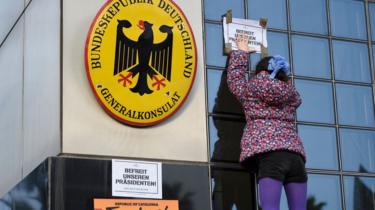 Image copyrightAFPImage captionA sign saying "Free our president" is attached to the German consulate in Barcelona
Smaller demonstrations were held in Girona, where Mr Puigdemont once served as mayor, Tarragona and Lleida. Some protesters also formed road blocks in various locations.
Tensions in Catalonia are very high and its separatist leaders abandoned plans to name a new president after the arrest on Friday of the latest candidate, Jordi Turull, sparked protests in Barcelona.
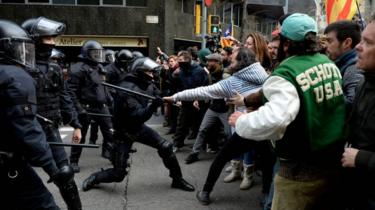 Image copyrightAFPImage captionScuffles broke out between police and protesters in Barcelona
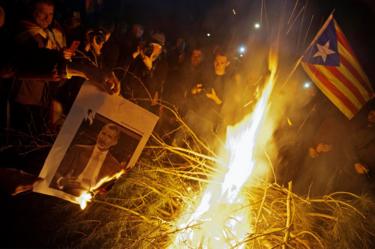 Image copyrightEPAImage captionAn image of Spain's King Felipe VI was burnt at a protest in Girona
Spain's Supreme Court has ruled 25 that Catalan leaders should be tried for rebellion, embezzlement or disobeying the state. They all deny the allegations.
How was Carles Puigdemont caught?
German police said that Mr Puigdemont was detained by a highway patrol in the northern state of Schleswig-Holstein, which borders Denmark.
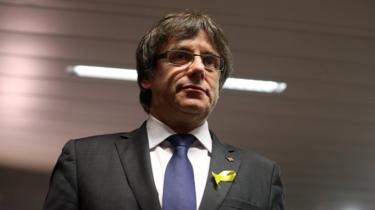 Image copyrightGETTY IMAGESImage captionMr Puigdemont had been living in Belgium
He had been on a trip to Finland to meet lawmakers and attend a conference last week when the arrest warrant against him was reissued, taking him by surprise.
He slipped out of Finland before the authorities could arrest him but only got as far as Germany before being intercepted.
End of Twitter post by @15MBcn_int
His spokesman, Joan Maria Pique, said he had been heading to Belgium "to put himself, as always, at the disposal of Belgian justice".
International warrants for Mr Puigdemont and other Catalan leaders were withdrawn in December by a Spanish judge, who said they had shown a willingness to return to the country.
What happens next?
Mr Puigdemont has spent the night in a prison in the north German town of Neumünster.
His court appearance on Monday will be a formality to confirm his identity.
The former Catalan leader faces charges of sedition, rebellion, and misappropriation of public funds as a result of his role in last year's Catalan independence referendum, which had been banned by Spanish authorities.
German judges will have to assess if there is an equivalent to the Spanish charges in German law. This is known as "dual criminality".
Criminal lawyer Martin Heger told Germany's Spiegel website that misappropriation of public funds was also a crime under German law and therefore it was clear that the exiled ex-leader would have to be extradited within 60 days.
German judges do not have to prove an offence has taken place.
The extradition procedure lasts about two months. If it formally begins, then a judge will decide whether Mr Puigdemont will be kept in custody.
The charges he faces in Spain could result in up to 30 years in prison.
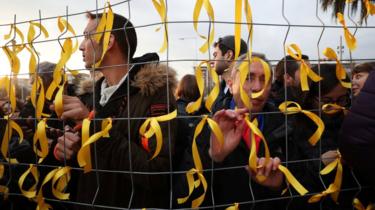 Image copyrightREUTERSImage captionPeople tie yellow ribbons - a symbol of support for Catalonian political prisoners - to a fence outside the German Consulate in Barcelona
Spain's latest move is considered the most serious challenge to date to the Catalan independence movement. Almost the entire leadership now faces a major legal fight.
Various other Catalan politicians have been subjected to new warrants, including Catalonia's former education minister, Clara Ponsati. She is in Scotland, where she has a position at the University of St Andrews, and is preparing to hand herself in.
How we got here
Media captionWhy is there a Catalan crisis? The answer is in its past, as Europe correspondent Gavin Lee explains
1 October 2017: The independence referendum takes place in Catalonia; it is deemed illegal by Spain and boycotted by many potential voters
27 October: Catalonia's leaders declare independence, which leads to the Spanish government imposing direct rule on the region and dissolving its parliament
30 October: Charges of rebellion, sedition and misuse of public funds are brought against various sacked members of the Catalan government, including Mr Puigdemont
2 November: Several former Catalan ministers are taken into custody in Spain
3 November: European Arrest Warrants are issued against Mr Puigdemont and four of his allies, who have all fled to Belgium
5 December: A Spanish judge withdraws the European arrest warrants but says the group still face possible charges for sedition and rebellion
21 December: Carles Puigdemont is re-elected to parliament during Catalan's regional elections - which Spanish PM Mariano Rajoy had called to "restore democracy"
1 March 2018: Mr Puigdemont says he is stepping aside and he backs detained activist Jordi Sanchez to run as Catalonia's president
21 March: Mr Sanchez drops his leadership bid and instead the candidacy is passed to Jordi Turull, who the following day is rejected by hardline separatists
23 March: Mr Turull and various others are arrested in Spain, and the European arrest warrants are reissued
25 March: Mr Puigdemont is detained in Germany


No comments:
Post a Comment